High Temperature Battery and Lipo Battery Solutions
High Temperature Battery and Lipo Battery Solutions: Engineering Power for Extreme Environments and Modern Devices
In an era where electronic devices are pushed deeper into oil wells, closer to engine blocks, thinner into wearables, and longer into remote monitoring stations, the demand for reliable energy storage has never been more demanding. Two battery chemistries have emerged as the backbone of this push: the high temperature battery, built to survive and perform where ordinary cells degrade within hours, and the Lipo battery (lithium polymer battery), prized for its ultra-thin form factor, light weight, and customizable shape. At Guangzhou Serui Battery Technology Co., Ltd. (SERUI Battery, www.serui-battery.com), we design and manufacture both categories—along with complete custom battery pack assemblies—for customers across more than thirty countries.
This guide explains what makes a high temperature battery truly capable, where a Lipo battery outshines other chemistries, and how SERUI combines precision engineering, rigorous testing, and flexible customization to deliver power solutions that fit your product, not the other way around.
The Quiet Revolution: Why Battery Chemistry Matters More Than Ever
Every electronic product is only as reliable as the cell inside it. A sensor that stops working at 85 °C can cost an oil operator tens of thousands of dollars in downtime. A medical device that bulges in a patient's pocket creates a safety incident. A drone that sagged mid-flight because its Lipo battery could not deliver burst current loses its payload—and its customer's trust.
Battery selection is therefore not a sourcing afterthought. It is a core engineering decision that touches safety, certification, product lifetime, warranty cost, and brand reputation. Two questions drive nearly every design-in conversation at SERUI:
What is the harshest environment the cell will see? (Temperature range, vibration, humidity, thermal cycling.)
What shape, weight, and discharge profile does the device demand? (Thinness, burst current, voltage, capacity.)
For the first question, the answer is often a high temperature battery built on lithium thionyl chloride (Li-SOCl₂) or other high-grade chemistries. For the second, the answer is frequently a Lipo battery based on lithium manganese dioxide (Li-MnO₂) pouch construction. SERUI engineers both, and integrates them into finished packs with protection circuits, connectors, and wire harnesses tailored to the end product.
High Temperature Battery: Power Beyond the 60 °C Ceiling
2.1 What Is a High Temperature Battery?
A standard consumer lithium-ion cell is typically rated for an operating range of roughly –20 °C to 60 °C. Above 60 °C, the electrolyte breaks down, the SEI layer on the anode destabilizes, self-discharge accelerates, and cycle life collapses. A high temperature battery is engineered specifically to operate continuously at 85 °C, 100 °C, 125 °C, and in specialized SERUI configurations up to 150 °C, while still delivering stable voltage, low self-discharge, and a safe service life measured in years.
The challenge is not simply "making the cell hotter." It is maintaining electrochemical stability across three fronts simultaneously:
Electrolyte formulation that does not evaporate or decompose at elevated temperatures.
Separator materials that remain dimensionally stable and do not shrink or short.
Cathode/anode systems whose reaction kinetics do not runaway when thermal stress combines with load.
2.2 Li-SOCl₂: The Workhorse of High Temperature Applications
SERUI's high-temperature lineup is anchored on lithium thionyl chloride (Li-SOCl₂) chemistry—the ER series cylindrical cells such as ER34615, ER26500, and ER14505, along with high-drain variants designated by the "H" or "S" suffix (e.g., ER34615H, ER34615S, ER26500S, ER14505S).
Li-SOCl₂ chemistry offers a rare combination of properties that make it the default choice for demanding high-temperature and long-lifetime deployments:
High open-circuit voltage (3.6 V) that reduces the number of cells needed in series.
Extremely low self-discharge—typically less than 1% per year—enabling 10-to-20-year device lifetimes.
Wide operating temperature, reliably serving from –55 °C to +85 °C in standard versions and up to +150 °C in high-temperature grades.
High energy density, which matters when the device enclosure cannot grow.
Stable voltage under load, even after long storage, thanks to the passivation layer behavior engineered in production.
The trade-off with Li-SOCl₂ is that it is a primary (non-rechargeable) chemistry, and its initial "voltage delay" under very light loads—often discussed at the 20 µA trickle-current level—must be understood and managed. SERUI's application engineers work with customers from the earliest schematic stage to size cells, add appropriate pulse circuits, and specify the right variant so that the battery behaves predictably in the field.
2.3 Where a High Temperature Battery Earns Its Keep
The applications that rely on a true high temperature battery share a common trait: the installation location is hostile, and the device is difficult or impossible to retrieve.
Downhole oil and gas tools: logging tools, drilling sensors, and pressure gauges sit deep underground where geothermal heat climbs steadily.
Geothermal and industrial monitoring: sensors buried in steam lines, furnace controls, and kiln telemetry.
Under-hood automotive electronics: telematics, tire-pressure sensor gateways, and exhaust-region modules experience sustained heat soak.
Smart utility metering: AMR/AMI gas and water meters installed in pits, manholes, or uninsulated outdoor cabinets.
Aerospace and defense: black-box components, munitions safety devices, and cabin sensor arrays.
Outdoor communications: solar-assisted remote transmitters, pipeline monitors, and weather stations in desert climates.
In each case, the cost of a premature battery failure dwarfs the premium paid for a properly specified high temperature cell. SERUI's customers consistently tell us that the single most valuable question their engineering team can ask early is, "What is the maximum ambient temperature the cell will actually see, not just in the lab but on the hottest August afternoon with the device sealed inside a black enclosure?"
2.4 Designing for 150 °C: What "High Temperature" Really Means
A common sourcing mistake is assuming that a cell rated "up to 85 °C" can be pushed to 105 °C by derating the load. In practice, above the rated ceiling the electrolyte degrades non-linearly: self-discharge jumps, gas generation begins, and safety margins erode quickly. SERUI therefore recommends selecting a cell whose rated maximum exceeds the worst-case environment by a clear margin, rather than relying on derating alone.
For applications truly demanding 125 °C to 150 °C continuous operation, SERUI supplies purpose-built high-temperature grades with modified electrolyte, reinforced seals, and high-temperature-compatible hardware. These cells are qualified for low-to-moderate discharge currents typical of sensing and telemetry, and are paired in packs with high-temperature-rated PCBs, wires, and adhesives. A high temperature battery pack is only as reliable as its weakest sub-component—and that weak point is often the connector, not the cell.
Lipo Battery: Thin, Light, and Shaped Around Your Product
3.1 What Is a Lipo Battery?
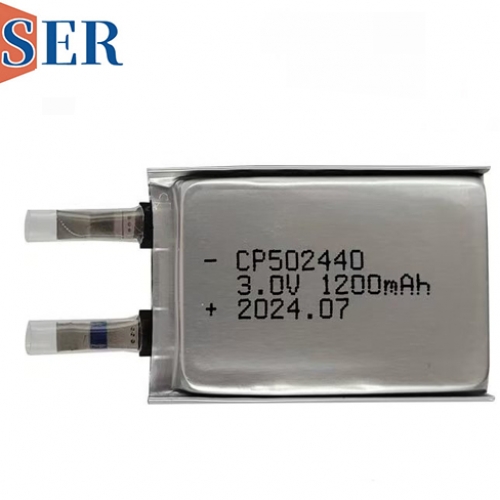
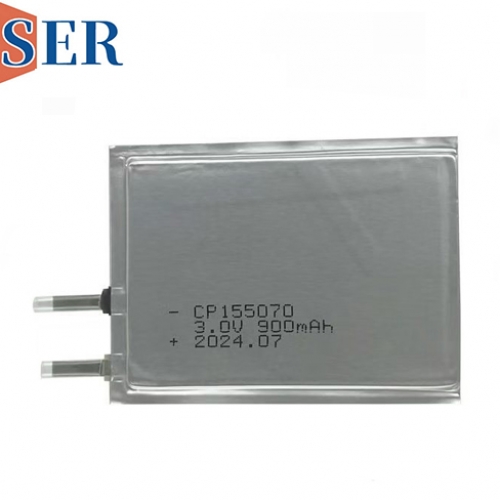
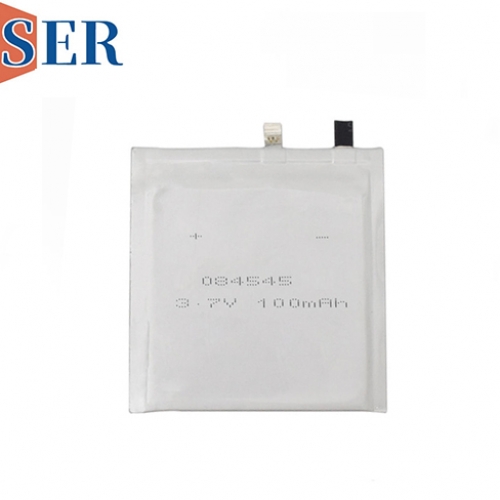
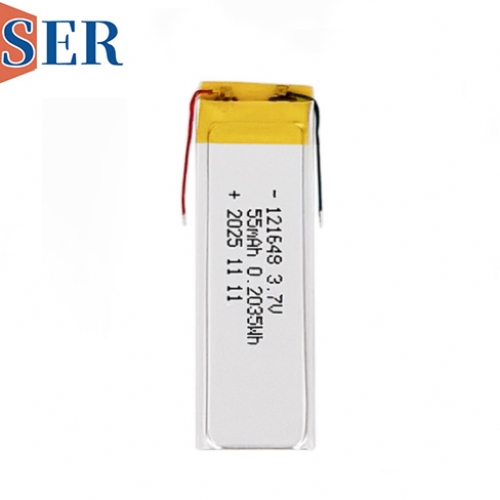
A Lipo battery—short for lithium polymer or lithium polymer electrolyte battery—uses a flexible, laminated aluminum-plastic film pouch instead of a rigid steel or aluminum can. This construction is what gives the Lipo battery its defining advantages:
Ultra-thin profiles, down to a few millimeters, in formats such as 0.8 mm, 1.0 mm, or 1.5 mm thickness.
Customizable shapes: rounded corners, notched outlines, wedge shapes, and other non-rectangular footprints that fill otherwise dead space inside a product.
Low weight because the pouch case is lighter than a metal can.
Low risk of rupture in abuse: the pouch vents rather than exploding, which is why medical and wearable designers favor it.
Low self-discharge and stable voltage suitable for both consumer and industrial devices.
SERUI's Lipo battery lineup centers on Li-MnO₂ (lithium manganese dioxide) soft pack cells, including compact form factors such as CP012525, CP012535, and CP114752, as well as rechargeable lithium-polymer variants where the application demands cycling.
3.2 The Lipo Battery Design Trade-off: Energy, Thickness, and Current
A Lipo battery is not universally "better" than a cylindrical cell. Its strengths come with deliberate trade-offs that a skilled pack designer manages.
Pouch cells have lower mechanical rigidity than cylindrical cans, so they must be compressed and constrained inside the product enclosure. Without proper pressure, cycle life and discharge performance suffer.
Very thin cells (under 2 mm) deliver limited capacity, which is why they are reserved for space-constrained devices rather than high-energy products.
Pouch cells require careful sealing—any puncture or electrolyte leakage path is a direct safety concern. SERUI uses automated hot-bar sealing and 100% visual and electrical inspection on pouch lines.
When these trade-offs are managed well, the Lipo battery enables products that would otherwise be impossible: a fitness band that sits flush against the wrist, a medical patch that adheres to skin, an industrial sensor card that slides into a slot milled into a metal housing.
3.3 Where a Lipo Battery Fits Best
Wearable and medical devices: smartwatches, earbuds, glucose monitor patches, hearing aids, and disposable medical sensors.
Ultra-thin consumer electronics: slim remote controls, Bluetooth trackers, smart cards, and portable POS terminals.
Industrial and IoT nodes: thin sensor modules, asset trackers, and label-shaped data loggers.
Custom-shaped assemblies: devices where the battery must wrap around a PCB or occupy an irregular cavity.
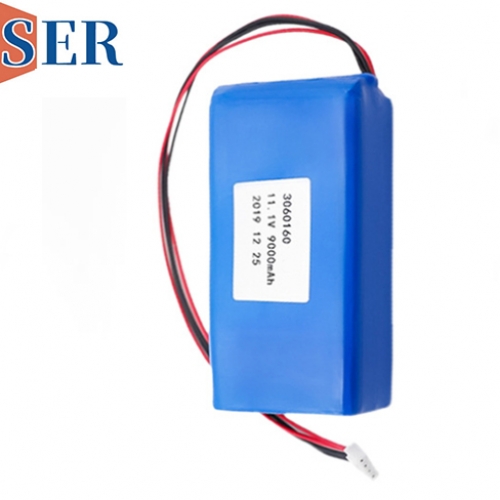
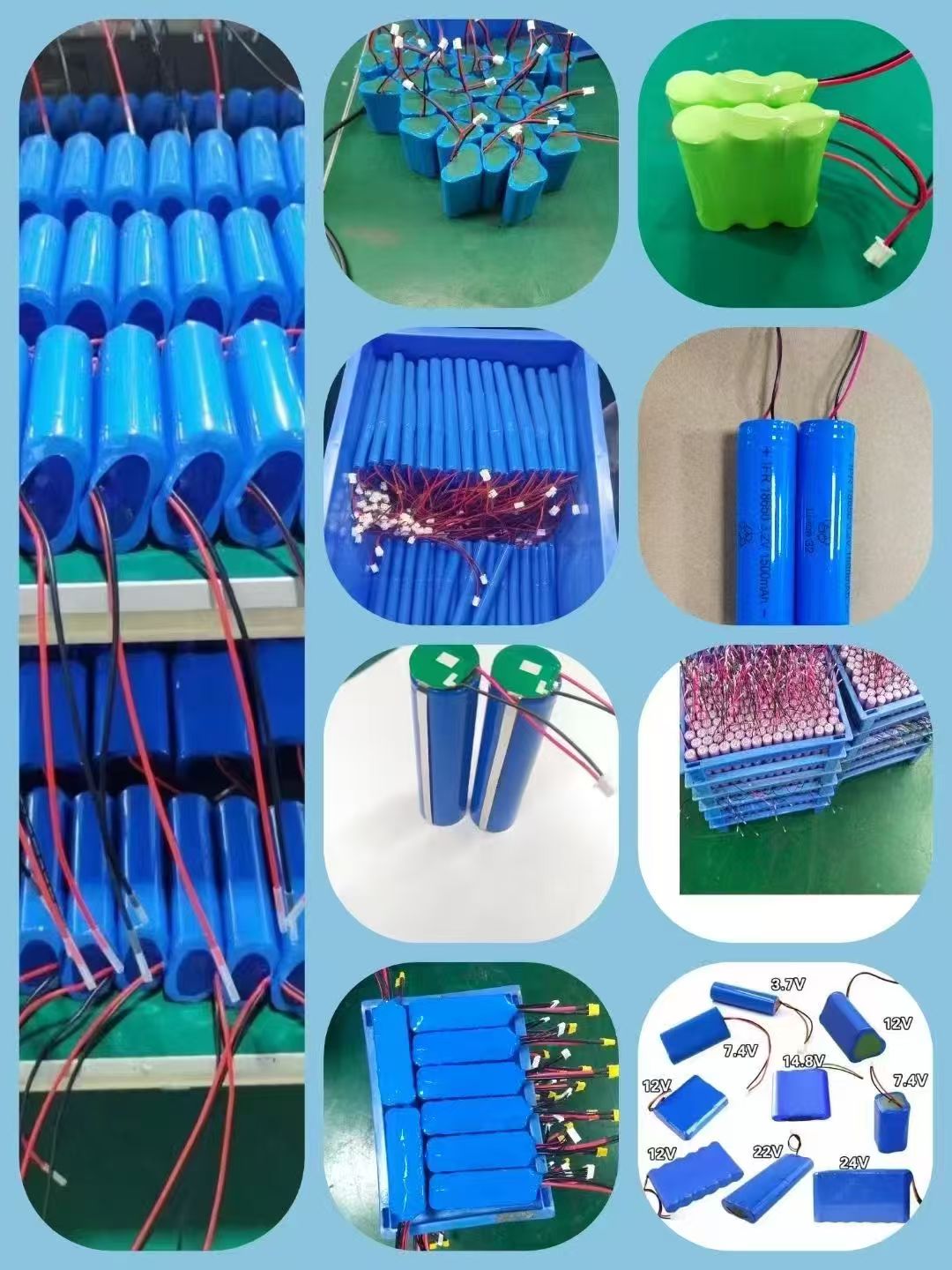
The photograph series supplied with this article shows the range SERUI can assemble: blue-wrapped cylindrical cells in parallel and series configurations, finished packs with red-and-black flying leads and JST connectors, packs topped with green protection boards, and a voltage family covering 3.7 V, 7.4 V, 12 V, 14.8 V, 22 V, and 24 V. Many of these packs are built around Lipo or cylindrical Li-SOCl₂ cores, integrated with PCM/BMS, overcurrent protection, and customer-specified connectors.
From Cell to Pack: SERUI's Custom Battery Assembly Capability
Supplying a good cell is necessary but not sufficient. Most product teams need a finished battery pack: cells welded, protected, insulated, and terminated with a connector that plugs straight into their motherboard. The reference images in this article show that workflow in action.
4.1 Cylindrical Cell Pack Assembly
SERUI's cylindrical packs are built on 18650, 18500, 14500, 26500, and 34615 form factors, among others. The production sequence visible in the photographs includes:
Cell sorting by internal resistance and open-circuit voltage to within tight tolerances.
Soldering or spot-welding of nickel strips in precise series and parallel configurations.
Insulation wrapping in heat-shrink PVC (the blue sleeves seen in the images).
Protection board integration, including the green-topped PCBs with fly leads that protect against overcharge, over-discharge, and short circuit.
Harness and connector attachment, with JST, PH, XH, or custom connectors per the customer's CAD.
Aging and final inspection on the multi-tray racks where finished packs rest under electrical load before shipment.
The blue trays filled with rows of cells and red-and-black leads show the in-process stages: cells in formation, packs awaiting final wrapping, and bulk aging racks. This is the behind-the-scenes work that turns loose cells into a certified, drop-in power module.
4.2 Voltage and Configuration Flexibility
One of the most common questions from new customers is, "Can you build a pack at exactly the voltage my board expects?" The answer is yes. The voltage family shown—3.7 V, 7.4 V, 12 V, 14.8 V, 22 V, and 24 V—is illustrative of SERUI's standard range, but packs can be configured to nearly any nominal voltage between roughly 3 V and 30 V by adjusting the number of cells in series.
3.7 V packs: single-cell Lipo or Li-ion, for slim single-board devices.
7.4 V packs: 2S configuration for medium-power portable equipment.
11.1 V / 12 V packs: 3S, the workhorse for portable instruments and small power tools.
14.8 V packs: 4S for higher-drain industrial devices.
22 V / 24 V packs: 6S to 7S configurations for light mobility, robotics, and stationary backup applications.
Each configuration is paired with a protection board matched to the chemistry (Li-SOCl₂, Li-MnO₂, or rechargeable Li-ion) and to the expected maximum continuous and pulse current.
4.3 High Temperature Packs, Not Just High Temperature Cells
A point SERUI emphasizes repeatedly: a high temperature battery pack is a system. Even if the cells themselves are rated to 150 °C, a standard-grade PCB, a PVC heat-shrink tube, or a generic adhesive connector can become the failure point. For elevated-temperature projects, SERUI specifies high-temperature PCBs, Teflon or silicone-insulated wire, Kapton or high-temperature Mylar insulation, and rated structural adhesives—so that the entire pack, not merely the cell, holds its rating.
4.4 Custom Labeling, Packaging, and Documentation
Beyond the electrical and mechanical build, SERUI treats the paperwork and physical packaging as part of the deliverable. Each pack can be supplied with customer-approved labels—including part number, barcode, capacity, voltage, date code, and compliance marks—applied to the shrink wrap or pouch surface. Anti-static and shock-absorbent packaging is standardized for international freight, and every carton is packed to the UN lithium-battery packing instructions so that air, sea, and rail shipments clear smoothly.
For OEMs with internal quality systems, SERUI provides the production records customers need: cell lot traceability, weld and protection-board test data, initial calibration reports, and the UN38.3 summary. This documentation package shortens incoming-inspection time and makes it easier for our customers to defend their own audits with end customers and notified bodies.
Quality, Certification, and Supply Reliability
For industrial, medical, and automotive-adjacent customers, a sample that performs beautifully is only the beginning. Production must be repeatable, traceable, and certified.
5.1 UN38.3 and Transport Safety
Lithium batteries shipped internationally must pass UN38.3, the United Nations standard covering altitude simulation, thermal testing, vibration, shock, external short circuit, impact, overcharge, and forced discharge. Every SERUI shipment of a high temperature battery or Lipo battery pack is supported by the relevant UN38.3 test summary, enabling our customers—from small European distributors to large American OEMs—to clear freight forwarders and customs without delay.
5.2 Incoming, In-Process, and Outgoing Inspection
The aging racks and sorted-cell trays visible in the photographs reflect a discipline of measurement at every stage:
Incoming cell audit: each lot is sampled for OCV, IR, and dimensional conformance.
Weld strength checks: pull-test frequency on nickel tabs to prevent intermittent connections in the field.
In-circuit protection verification: every pack is tested for over-discharge and short-circuit response.
Final aging: packs rest under light load before final OCV confirmation, so the customer receives a pack whose voltage reflects true rest state.
5.3 Long-Run Consistency for 50K, 100K, and 300K Orders
SERUI supports production runs that scale from prototype quantities measured in dozens to volume orders measured in hundreds of thousands. For larger programs—such as the 50K, 100K, and 300K packs our team has scheduled for customers in Ecuador, Denmark, South Korea, and the United States—we run dedicated build slots, lock cell lots, and stage materials in advance so that production lead time remains predictable even when raw-material cycles tighten.
This is also why our account team talks openly with customers about payment milestones, material lead times, and production scheduling early in the relationship. A high temperature battery program that starts in autumn for a spring product launch leaves enough buffer for cell allocation, tooling, validation, and sea freight—and avoids the compressed "rush at the dock" scenario that hurts both sides.
Matching the Right Chemistry to Your Product
Customers often ask us, "Should I use a high temperature battery or a Lipo battery?" The honest answer is that they solve different problems, and some products use both. The decision usually follows this logic:
Decision factor | High temperature battery (Li-SOCl₂) | Lipo battery (Li-MnO₂ pouch) |
Primary mission | Long life, high ambient temperature, low drain | Thin shape, light weight, custom form |
Typical temperature range | –55 °C to +85/150 °C | –20 °C to +60 °C |
Rechargeable | No (primary) | Primary Li-MnO₂ or rechargeable Li-Po options |
Self-discharge | Extremely low (<1%/year) | Low |
Preferred shape | Cylindrical (ER series) | Thin, custom pouch |
Typical lifetime | 10–20 years in the field | 3–10 years depending on use |
Best-fit applications | Downhole, AMR metering, industrial sensors | Wearables, medical patches, slim IoT devices |
When a device must survive both a thin enclosure and a hot environment, SERUI engineers will sometimes propose a hybrid: a high-temperature primary cell for long-life backup power, paired with a smaller Lipo element for pulse or shape-critical functions. These mixed-chemistry packs require careful protection design, but they are routinely built in our facility.
Beyond the Catalog: Why Customers Work With SERUI Battery
With cell manufacturers and trading companies abundant across China, buyers often ask what sets SERUI apart. The answer, distilled from years of foreign-trade work with customers on four continents, comes down to four points:
1. We speak both engineering and commercial language. Our team can translate an engineer's description of a 20 µA lag effect or a 4 mA versus 30 mA discharge curve into a precise part number and a production plan—and then explain that plan, in plain English, to a procurement manager who only cares about lead time and price.
2. We will tell you if your spec is risky. If a customer asks for a 150 °C pouch pack where the cells are only rated to 85 °C, we do not quietly accept the order. We explain the thermal margin problem, propose a high-temperature grade, and show the test data. Over the long run, that honesty prevents field failures and warranty claims.
3. We handle the full stack. From cell selection and pack design to protection circuitry, connector specification, UN38.3 documentation, and export packing, customers receive a finished, tested product—not a bag of cells and a schematic.
4. We scale with your program. Whether you are validating a new medical device in San Francisco or rolling out a 300K-unit smart meter program in Central America, the same engineering rigor applies. Prototype batches and volume orders come off the same lines, to the same drawings.
Frequently Asked Questions
Q: What is the maximum temperature a SERUI high temperature battery can handle? A: Standard Li-SOCl₂ ER cells operate reliably up to 85 °C. Our dedicated high-temperature grades are qualified for continuous operation up to 125 °C, and specialized configurations reach 150 °C for appropriate low-to-moderate discharge applications. The exact rating depends on cell size, current draw, and duty cycle.
Q: Can a Lipo battery be used outdoors in summer? A: Standard Lipo battery packs are rated up to 60 °C. For sealed outdoor enclosures that can exceed 60 °C in direct sun, we recommend either a high-temperature-grade cell or active thermal design. We will review your worst-case enclosure temperature before confirming a pouch pack.
Q: Do you supply cells only, or finished packs? A: Both. We ship bare cells for customers with their own pack lines, and finished packs with PCM/BMS, wires, and connectors for OEMs who want a drop-in module. The photographs in this article show examples of both in-process and finished pack stages.
Q: What certifications do your packs carry? A: All lithium battery shipments are UN38.3 tested. Many standard packs also carry CB, CE, and RoHS documentation; specific medical or automotive certifications are project-dependent and discussed during development.
Q: What is your typical lead time? A: Prototype packs usually ship within 1–2 weeks. Volume production depends on cell availability and order size, and is quoted against a confirmed purchase order with locked specifications.
Conclusion: Power Designed Around Your Product, Not Around the Catalog
The gap between a "good enough" battery and a field-proven power solution is where engineering, testing, and honest communication meet. A high temperature battery that survives a decade in a downhole tool, or a Lipo battery that disappears into a 1.2 mm wearable enclosure, is not selected from a catalog—it is co-designed by a manufacturer who understands both the chemistry and the customer's application.
At SERUI Battery, we build both chemistries, assemble them into finished packs at voltages from 3.7 V to 24 V and beyond, and stand behind every shipment with UN38.3 documentation, traceable materials, and a technical team that answers in plain English. Whether your challenge is surviving 150 °C in an oil well or fitting 50 mAh into a 2 mm wristband, we would like to hear about it.
Contact SERUI Battery today at www.serui-battery.com to discuss your high temperature battery or Lipo battery pack requirements. Share your mechanical drawing, target environment, and discharge profile, and our engineering team will return a recommended configuration, a realistic lead time, and an honest assessment of any thermal or design risks—before you commit to a purchase order.
SER GROUP LIMITED / Guangzhou Serui Battery Technology Co., Ltd. — Custom lithium battery packs for extreme environments and slim modern devices.