LiSOCL2 Battery ER26500 HPC1520 | 3.6V Non‑Rechargeable High Pulse 2A for Smart Meters, Fire & IoT Devices | SER Battery
LiSOCL2 Battery ER26500 HPC1520: 3.6V Non‑Rechargeable High‑Pulse Power Source for Smart Meters, Fire Equipment and IoT Devices
Published by SER Group | www.serui‑battery.com
In today’s rapidly expanding IoT ecosystem, billions of field‑deployed intelligent terminals rely entirely on reliable, maintenance‑free primary power sources. Smart water meters, natural gas meters, fire safety monitoring equipment, remote industrial sensors and various low‑power IoT devices share identical strict requirements: stable base current supply, capability to deliver large instant pulse current for wireless data transmission, multi‑year service cycle, minimal capacity loss during long‑term standby, and proven safety in harsh outdoor or buried installation environments. Rechargeable lithium‑ion batteries and conventional alkaline batteries cannot fully satisfy these combined technical demands, especially for equipment that is difficult to access for frequent battery replacement. Many project operators have encountered real‑world headaches including unexpected device reset, remote reading failure, early battery depletion and high on‑site maintenance costs caused by inferior battery solutions. As a professional and leading LiSOCL2 battery supplier, SER GROUP dedicates to developing high‑performance lithium thionyl chloride primary battery solutions to solve real‑world power‑supply pain points for global industrial customers. Among our full‑range product portfolio, the 3.6V non‑rechargeable LiSOCL2 battery ER26500 HPC1520, together with derivative variants ER26500+SPC1520 and Er26500 Plus EPC1520, stands out as a benchmark hybrid pulse battery module built for modern industrial IoT applications. This article will dive deep into core strengths including High Pulse 2A high‑current output, long service life, low self‑discharge rate, non‑rechargeable safety features, and real‑world deployment across smart water meter, natural gas meter, fire equipment and diverse IoT device scenarios, helping design engineers, procurement specialists and solution integrators make well‑informed battery selection decisions.
1. Understanding SER LiSOCL2 Battery ER26500 Series Hybrid Pulse Modules
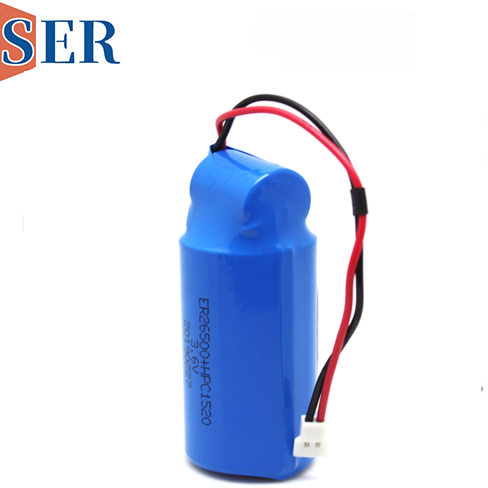
Lithium‑thionyl chloride (LiSOCL₂) chemistry is widely accepted as one of the most mature primary lithium battery technologies for industrial use, delivering stable 3.6V nominal voltage, high energy density, broad temperature adaptability and outstanding long‑term static performance. Standard bobbin‑type ER26500 C‑size cells offer huge capacity but suffer obvious voltage drop when facing sudden high‑current pulse loads triggered by NB‑IoT, LoRaWAN or alarm signal transmission, which often leads to communication failure, data packet loss or false equipment alarms in practical IoT projects. To eliminate this bottleneck, SER integrates ER26500 base cell with specialized hybrid pulse capacitor units, launching three mainstream assembled modules: ER26500 HPC1520, ER26500+SPC1520, and Er26500 Plus EPC1520. All are non‑rechargeable 3.6V LiSOCL2 battery assemblies built on spiral‑wound high‑capacity ER26500 cells with typical capacity reaching 8500mAh.
The working principle of these hybrid structures is clear: the LiSOCL2 main cell provides steady low‑level base current for sensor sampling, microcontroller sleep‑mode consumption and trickle charging of the parallel pulse capacitor; meanwhile the attached 1520‑form‑factor pulse capacitor releases instant large current up to High Pulse 2A whenever the IoT device wakes up, sends wireless packets or activates fire alarm triggers. This power‑sharing mechanism separates long‑duration low‑current duty and short‑time high‑pulse duty perfectly, avoiding cell polarization and voltage sag that trouble bare ER26500 cells under pulse stress.
There are subtle positioning differences among SER’s three key models. ER26500 HPC1520 is our flagship high‑pulse variant optimized for maximum 2A pulse output, targeting heavy‑transmission smart meters and high‑frequency alarm‑triggering fire equipment. ER26500+SPC1520 balances pulse capability and cost‑effectiveness, the preferred option for mass‑volume smart water meter and natural gas meter projects with moderate pulse frequency requirements. Er26500 Plus EPC1520 features enhanced low‑temperature pulse performance and optimized internal impedance, best suited for outdoor IoT devices working in cold northern field environments or sites with large temperature fluctuation. Every SER LiSOCL2 battery module passes strict UN38.3, MSDS and RoHS compliance testing, supporting custom wire harness, connector and insulating housing modifications according to customer mechanical drawing requirements, as introduced on our official website www.serui‑battery.com. Before mass order placement, SER strongly recommends prototype sample testing under customers’ actual working current profile to verify full compatibility between ER26500 HPC1520, ER26500+SPC1520 or Er26500 Plus EPC1520 and end hardware.
2. Core Advantage One: High Pulse 2A High‑Current Capability Solves IoT Pulse Pain Points
One most frustrating engineering problem for IoT hardware designers using bare LiSOCL2 cells is pulse voltage dip. When NB‑IoT modules turn on for uplink transmission, instant current demand may surge to 1A‑2A within tens of milliseconds. Ordinary standalone ER26500 cells can only sustain roughly 200‑300mA pulse without significant voltage falling, which causes the MCU or communication chip to reset unexpectedly, generating missing meter readings and unstable system operation. SER’s ER26500 HPC1520 is purpose‑built to resolve this exact problem, delivering reliable High Pulse 2A peak high‑current output thanks to matched hybrid pulse capacitor design.
With the ER26500 HPC1520 module, the LiSOCL2 cell keeps slowly topping‑up the HPC1520 pulse capacitor during device long sleep intervals. Once the IoT terminal wakes up to upload data, the capacitor immediately supplies 2A large pulse current, while the main cell only bears small continuous background load. This greatly reduces polarization inside the lithium‑thionyl chloride cell, keeps terminal voltage above chip minimum operating threshold throughout pulse events, and prevents reset, communication abort or alarm misfire. Both ER26500+SPC1520 and Er26500 Plus EPC1520 inherit this hybrid power architecture. ER26500+SPC1520 provides stable high‑pulse performance for general metering applications; Er26500 Plus EPC1520 improves low‑temperature pulse characteristic, maintaining decent high‑current output even under minus‑degree ambient conditions, a vital merit for outdoor field‑installed IoT devices.
This High Pulse 2A high‑current advantage brings tangible project‑level value. For smart water meter and natural gas meter fleets deployed city‑wide, it drastically cuts remote meter‑reading failure rates. For fire equipment such as intelligent fire hydrant monitors and smoke detection nodes, reliable large‑pulse delivery ensures alarm signals can be transmitted instantly whenever risk conditions are detected, without power‑related signal loss. For general IoT devices including remote environmental sensors, waste bin monitors and site tracking terminals, SER LiSOCL2 battery hybrid modules guarantee consistent wireless transmission performance over the whole battery lifespan, reducing field maintenance workload significantly. Many customers previously attempted adding discrete external capacitors on their PCB to achieve pulse improvement, but that increases BOM cost, occupies valuable board space and brings consistency risks from component‑to‑component tolerance. Adopting finished assemblies like ER26500 HPC1520, ER26500+SPC1520 or Er26500 Plus EPC1520 shifts capacitor‑cell matching validation work to SER’s battery laboratory, simplifying customers’ hardware design cycles and improving end‑product batch consistency.
3. Core Advantage Two: Long Life for Decade‑Level Maintenance‑Free Field Operation
Service life is a decisive purchasing factor for batteries used in smart water meter, natural gas meter, fire equipment and mass IoT device roll‑outs. Most of these units are mounted underground, inside valve wells, on high‑rise walls or in remote industrial zones. Sending technicians out to replace batteries generates huge labor and logistics expense; in some scenarios, device shutdown during battery swap will interfere with public utility services. Therefore market expectation is for batteries to match the full equipment service life, ideally 10 years or longer, with zero on‑site battery intervention. Being non‑rechargeable primary power sources, SER ER26500 HPC1520, ER26500+SPC1520 and Er26500 Plus EPC1520 leverage the chemical stability of LiSOCL₂ chemistry and optimized spiral‑wound cell construction to achieve impressive long‑life performance.
Unlike rechargeable lithium‑ion cells which degrade through charge‑discharge cycling and suffer swelling risks, these LiSOCL2 battery modules operate under one‑time discharge mode. As long as devices work in typical IoT duty cycle: most time staying in micro‑ampere sleep mode, short‑time active sampling plus periodic pulse transmission, SER ER26500‑series hybrid modules can support 10‑15‑year field operation under normal ambient temperature. The full‑sealed metal cell canister and glass‑to‑metal hermetic sealing structure block moisture and air ingress, suppressing internal side reactions that would shorten operational lifespan.
For smart water meter and natural gas meter manufacturers, long‑life battery performance directly defines product market competitiveness. If batteries fail after only 4‑6 years, meter operators face massive retrofitting costs and customer complaints. By selecting SER ER26500 HPC1520 or ER26500+SPC1520, meter OEMs can confidently promise end‑users decade‑long maintenance‑free metering service. For fire equipment, long battery life is also safety‑related: premature battery depletion will render monitoring and alarm nodes non‑functional without early notice, creating hidden safety hazards. Er26500 Plus EPC1520, with its stable ageing performance across wide temperature spectrum, fits fire‑safety IoT terminals exposed to summer heat and winter cold. For general IoT device scenarios such as agricultural remote monitoring and smart parking sensors, long‑life characteristic lowers total ownership cost for project operators, cutting the frequency of site visits.
It is worth noting that actual service life correlates with average current draw, pulse frequency and operating temperature. SER’s engineering team at www.serui‑battery.com offers free‑of‑charge life‑simulation support according to customers’ device current profile, helping customers select among ER26500 HPC1520, ER26500+SPC1520 and Er26500 Plus EPC1520 and predict real‑world runtime accurately.
4. Core Advantage Three: Low Self‑Discharge Rate Guarantees Shelf Life and Long‑Term Standby
Even with sufficient nominal capacity, a battery with high self‑discharge will lose substantial capacity while sitting idle, either during factory inventory storage or long‑term field standby. Self‑discharge describes spontaneous internal chemical reactions that consume capacity under open‑circuit no‑load conditions, and it is another highlight of SER LiSOCL2 battery ER26500 hybrid family.
SER‑manufactured ER26500 HPC1520, ER26500+SPC1520 and Er26500 Plus EPC1520 adopt high‑purity electrolyte formulation, precise winding process and reliable hermetic sealing. Under 25℃ normal ambient condition, annual self‑discharge rate is controlled below 1%, meaning more than 90% of original capacity can be retained after 10‑year storage or standby period. Compare this to alkaline batteries with annual self‑discharge above 5%, or many low‑grade lithium primary cells with fast capacity fading in warm environments. The low self‑discharge rate brings two major practical benefits for industrial customers.
First benefit relates to production and stock management. Smart water meter, natural gas meter, fire equipment and IoT device OEMs often produce finished goods in large batches, which may sit in warehouse for 1‑3 years before shipment and field installation. If batteries have high self‑discharge, meters could arrive at project sites already with significant capacity consumed, resulting in shortened usable life after deployment. Thanks to low self‑discharge performance of SER LiSOCL2 battery, finished equipment can be safely stockpiled for years without worrying about battery deterioration, reducing scrap loss for manufacturers.
Second benefit is for field‑standby IoT working mode. Countless IoT devices stay dormant for months, only waking up for data sampling and transmission at long intervals. During those long dormant periods, battery self‑discharge becomes one dominant source of capacity consumption. ER26500 HPC1520, ER26500+SPC1520 and Er26500 Plus EPC1520 minimize this idle capacity waste, so almost all stored energy can be used for real device functions instead of being eaten away inside the cell. Even for equipment sitting standby for several years before triggering occasional alarm events, like certain fire‑safety sensors, low self‑discharge ensures adequate remaining capacity when emergency pulses are needed. While Er26500 Plus EPC1520 optimizes pulse performance under variable temperatures, it still maintains the same excellent low self‑discharge baseline of the whole SER ER26500 hybrid product line.
5. Core Advantage Four: Non‑Rechargeable Design Delivers Enhanced Safety and Stable Discharge
All models including ER26500 HPC1520, ER26500+SPC1520, Er26500 Plus EPC1520 belong to non‑rechargeable primary LiSOCL2 battery. Many customers ask: why not choose rechargeable batteries for IoT projects? In safety‑focused industrial scenarios such as smart water meter, natural gas meter and fire equipment, non‑rechargeable primary lithium architecture carries distinct safety and reliability advantages.
Rechargeable lithium‑ion cells rely on complex protection IC circuits against over‑charge, over‑discharge, over‑current and thermal runaway. Extra protection components increase circuit complexity, raise failure probability and occupy PCB space. In field‑deployed devices without human supervision, abnormal leakage current or external circuit faults may accidentally attempt charging a Li‑ion cell, creating swelling or thermal risk. For LiSOCL₂ chemistry specifically, any charging attempt will trigger dangerous internal side reactions, so these cells are strictly designed as non‑rechargeable, one‑time‑use power sources. SER clearly marks non‑rechargeable warning on every finished ER26500 HPC1520, ER26500+SPC1520 and Er26500 Plus EPC1520 module.
During discharge process, SER LiSOCL2 battery maintains a remarkably flat 3.6V output curve through most of its capacity range. Voltage does not drop sharply until near cut‑off point. This stable voltage supply is critical for high‑precision metering chips, sensor circuits and communication modules inside smart water meter, natural gas meter and IoT device hardware. Voltage fluctuation will introduce measurement deviation or communication instability; the steady discharge characteristic of our non‑rechargeable ER26500 hybrid modules avoids such troubles. Combined with robust metal shell construction resistant to vibration, pressure and dampness, these battery assemblies cope well with tough real‑world installation environments for fire equipment and outdoor IoT nodes.
Of course, non‑rechargeable property means end‑users must replace the module once energy is exhausted. But given 10+‑year usable life, battery replacement frequency becomes extremely low for most smart meter and IoT projects. Compared with safety hazards and complexity brought by rechargeable alternatives, non‑rechargeable LiSOCL2 battery solution turns out to be more practical for this category of industrial equipment. On our official site www.serui‑battery.com, safety guidelines and application notes for ER26500 HPC1520, ER26500+SPC1520, Er26500 Plus EPC1520 are available for download for hardware engineers.
6. Application Scenarios: Widely Deployed for Smart Water Meter, Natural Gas Meter, Fire Equipment and IoT Devices
Combining High Pulse 2A high‑current capacity, long life, low self‑discharge rate and non‑rechargeable safety, SER’s LiSOCL2 battery hybrid modules serve broad application territory.
6.1 Smart Water Meter & Natural Gas Meter
Smart water meter and natural gas meter represent the largest‑volume application for ER26500 HPC1520 and ER26500+SPC1520. Modern NB‑IoT remote meters spend most time in low‑power sleep state, waking periodically to collect flow data and transmit reading to cloud platform, requiring instant large pulse current during wireless upload. Underground well installation brings wide temperature swing and demands long‑term service plus minimal self‑discharge. ER26500+SPC1520 is widely adopted for mass‑produced general‑spec smart water meter and gas meter. When projects adopt higher‑frequency data‑upload strategy or operate in relatively cold zones, customers upgrade to ER26500 HPC1520 for its 2A high‑pulse capability. Meter manufacturers value that SER can provide consistent batch quality and optional custom wire and connector configuration to match meter internal assembly structure.
6.2 Fire Equipment
Fire‑safety related IoT hardware includes intelligent fire hydrant monitoring units, smoke and temperature composite detectors, pipeline fire‑risk sensors and alarm trigger terminals. For fire equipment, reliability is paramount: whenever abnormal condition is detected, the battery must instantly deliver large pulse current to activate alarm and send warning signal, even after many years of standby. Er26500 Plus EPC1520 performs outstandingly for fire nodes installed outdoors, thanks to improved low‑temperature pulse property. ER26500 HPC1520 with certified High Pulse 2A output is selected for fire‑IoT devices that require frequent status reporting. Low self‑discharge rate ensures that even if the fire equipment sits in standby for years without event, enough power remains for emergency pulse transmission.
6.3 General IoT Devices
Beyond metering and fire‑safety sectors, SER LiSOCL2 battery ER26500‑series hybrid modules power a wide range of IoT devices: remote environmental monitoring sensors, smart waste bin sensors, agricultural field monitoring terminals, smart parking detectors, pipeline leakage loggers and other industrial wireless nodes. Different IoT projects have different pulse frequency, temperature condition and cost targets, so SER supplies three options: ER26500 HPC1520, ER26500+SPC1520, Er26500 Plus EPC1520. Hardware designers can select suitable model according to their device’s current profile, or reach SER technical support via www.serui‑battery.com for application‑oriented recommendation.
7. Why Choose SER as Your Professional LiSOCL2 Battery Supplier
The global market is flooded with various LiSOCL₂ battery products, but performance gaps exist in pulse consistency, self‑discharge control, batch‑to‑batch uniformity and certification completeness. As a professional leading LiSOCL2 battery supplier, SER GROUP focuses on primary lithium cell development and hybrid pulse‑capacitor assembly production. Our product portfolio covers standard ER cells as well as finished hybrid assemblies such as ER26500 HPC1520, ER26500+SPC1520, Er26500 Plus EPC1520.
First, we control quality from cell‑level manufacturing. SER implements strict raw‑material screening for lithium thionyl chloride cells, optimizes spiral‑wound process and electrolyte formula to guarantee long life and low self‑discharge rate. Every batch of finished hybrid modules goes through pulse‑discharge testing, high‑low‑temperature cycling and open‑circuit ageing inspection, to verify High Pulse 2A high‑current performance and stability. All products complete UN38.3 transportation certification, MSDS safety document and RoHS compliance, convenient for global ocean and air shipment.
Second, we provide flexible customization service. Customers may require different lead lengths, connector types, insulating sleeve shapes for smart water meter, natural gas meter, fire equipment or IoT device integration. SER supports OEM & ODM modification based on customer drawings for ER26500 HPC1520, ER26500+SPC1520, Er26500 Plus EPC1520. Our engineering team can also conduct life‑simulation calculation according to customers’ device power consumption parameters, helping you pick optimal LiSOCL2 battery solution and avoid over‑spec or insufficient‑spec battery selection.
Third, we offer stable large‑volume delivery capacity for mass‑market projects. Whether you need sample quantity for prototype testing or millions‑level bulk orders for city‑scale smart‑meter roll‑out, SER arranges reasonable production scheduling. Visit our official website www.serui‑battery.com to view full product specifications, download datasheets and submit technical inquiries.
8. Conclusion
The rise of smart water meter, natural gas meter, fire equipment and massive distributed IoT device networks raises higher standards for industrial primary batteries. Bare LiSOCL₂ cells struggle with instant high‑current pulse requirements; many alternative battery chemistries fall short in service life or self‑discharge performance. SER’s 3.6V non‑rechargeable LiSOCL2 battery hybrid family represented by ER26500 HPC1520, ER26500+SPC1520 and Er26500 Plus EPC1520 solves these real‑world engineering challenges in one integrated assembly.
ER26500 HPC1520 delivers dependable High Pulse 2A high‑current output, preventing voltage drop and communication failure during IoT wireless transmission. All three variants feature long‑life design supporting decade‑level field operation, ultra‑low self‑discharge rate preserving capacity during warehouse stock and long standby periods, plus mature non‑rechargeable primary‑lithium safety architecture. Whether you are developing smart water meter, natural gas meter, fire‑safety monitoring hardware or diversified IoT device products, these SER hybrid pulse modules deliver stable, maintenance‑free power supply, cutting long‑term project operational cost.
When you source industrial‑grade LiSOCL₂ primary battery for your next‑generation hardware projects, consider SER GROUP, your professional LiSOCL2 battery supplier. Please browse www.serui‑battery.com for detailed datasheets of ER26500 HPC1520, ER26500+SPC1520, Er26500 Plus EPC1520, request samples or communicate customization demands with our sales‑engineering team.