LiSOCL2 Battery ER26500+SPC1520: Long-Life Low Self-Discharge Power Solution for IoT Devices
LiSOCL2 Battery ER26500+1520: Long-Life Low Self-Discharge Power Solution for IoT and Industrial Devices
In the era of rapid global IoT (Internet of Things) development, intelligent terminal equipment has penetrated into water supply, gas supply, fire safety, industrial monitoring, and smart city construction. All these field-deployed devices share a core demand: stable, long-term, and maintenance-free power supply. Unlike consumer electronic devices that support frequent charging and replacement of batteries, industrial IoT equipment is usually installed in dispersed, inaccessible, and harsh environments, putting forward extremely high requirements for battery life, self-discharge performance, and operational stability. Among numerous industrial battery products, the LiSOCL2 battery series represented by ER26500+1520, ER26500 HPC1520, and Er26500 Plus EPC1520 has become the preferred power solution for high-end industrial IoT devices by virtue of its ultra-long service life, ultra-low self-discharge rate, stable non-rechargeable performance, and high-capacity design. This article will comprehensively analyze the core advantages, technical characteristics, application scenarios, and industrial value of this series of lithium thionyl chloride batteries, helping industry users fully understand the irreplaceable advantages of LiSOCL2 battery ER26500+1520 series in industrial intelligent power supply.
1. Overview of LiSOCL2 Battery ER26500+1520 Series Core Products
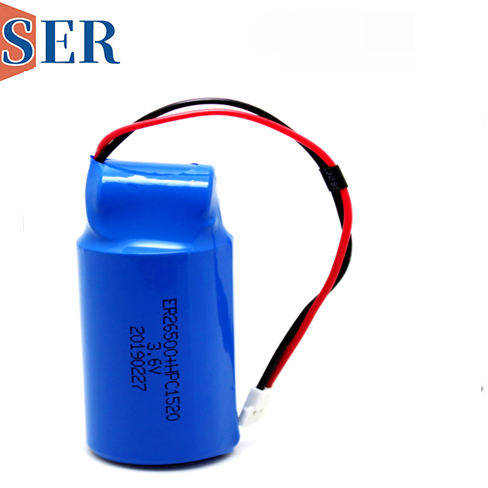
Lithium thionyl chloride (LiSOCL2) batteries are recognized as one of the most reliable primary lithium battery systems in the industrial power supply field. With a nominal voltage of 3.6V, they feature high energy density, wide temperature adaptation, and excellent long-term stability, which perfectly fills the performance gaps of traditional alkaline batteries and lithium-ion rechargeable batteries in industrial scenarios. The ER26500+1520 model is a classic upgraded product of the ER26500 spiral-wound C-size lithium thionyl chloride battery. On the basis of the standard ER26500 battery, it is matched with a high-performance pulse capacitor module (1520 specification), effectively solving the problem of instantaneous pulse power supply demand of IoT devices while maintaining the core advantages of the original battery.
In order to adapt to differentiated industrial power demands, the product series has derived two upgraded versions: ER26500 HPC1520 and Er26500 Plus EPC1520. The ER26500 HPC1520 is a customized high-capacity disposable lithium battery, which optimizes the internal cell structure and electrolyte formula, increasing the capacity up to 8500mAh, realizing higher energy storage efficiency under the same volume. The Er26500 Plus EPC1520 is a hybrid pulse capacitor integrated battery, which further optimizes the pulse discharge performance and low-temperature stability of the module, and is more suitable for complex and variable IoT working environments. All three core models belong to the non-rechargeable lithium battery category, focusing on long-term stable discharge and maintenance-free operation, and are widely applicable to smart water meters, natural gas meters, fire safety equipment, industrial IoT monitoring terminals and other core scenarios.
2. Core Advantage 1: Ultra-Long Service Life, Adapt to Long-Term Field Operation of IoT Devices
Service life is the primary indicator for industrial IoT equipment to select batteries. Most intelligent measuring instruments and monitoring terminals are fixed in outdoor, buried, or high-altitude environments, and battery replacement requires professional construction, high labor costs, and long construction cycles, which will even cause temporary suspension of equipment operation and affect the normal operation of urban public facilities and industrial systems. The LiSOCL2 battery ER26500+1520 series relies on the unique chemical stability of lithium thionyl chloride system and optimized spiral winding process to achieve an ultra-long service life that is far beyond traditional batteries.
Different from rechargeable lithium-ion batteries that are prone to capacity attenuation and cycle aging after multiple charge and discharge cycles, the non-rechargeable design of ER26500 HPC1520 and Er26500 Plus EPC1520 avoids the performance degradation risks caused by charge-discharge cycles. The internal chemical reaction of the battery is stable and controllable, with no obvious aging failure during long-term static storage and low-current discharge. In actual industrial applications, the continuous service life of this series of batteries can reach 10 to 15 years, which fully matches the full-life cycle service life of smart water meters, natural gas meters and fire equipment.
For IoT devices that work in a dormant standby + instantaneous wake-up sampling state for a long time, the long-life advantage of LiSOCL2 battery is particularly prominent. Most industrial IoT terminals are in low-power dormant state for most of the time, and only wake up briefly to complete data collection, transmission and signal feedback. Traditional batteries will gradually fail due to long-term static power consumption and chemical aging, while the ER26500+1520 series can maintain stable output power throughout the long-term standby process, ensure that the equipment does not shut down due to battery failure, and greatly reduce the equipment operation and maintenance cost. Whether it is urban public utility intelligent metering equipment or industrial safety monitoring IoT terminals, this ultra-long-life performance can realize truly "install once, use for life" maintenance-free operation.
3. Core Advantage 2: Ultra-Low Self-Discharge Rate, Excellent Long-Term Storage Performance
Self-discharge rate is a key parameter that determines the long-term standby performance of industrial batteries, and it is also one of the core competitive advantages of LiSOCL2 battery ER26500+1520 series. Self-discharge refers to the spontaneous loss of battery capacity caused by internal chemical reactions when the battery is in open-circuit standby state. The higher the self-discharge rate, the faster the battery capacity decays, and the shorter the standby service life, which is fatal for IoT devices that require long-term standby operation.
Traditional dry batteries and ordinary lithium batteries have a high self-discharge rate, with an annual capacity loss rate of more than 5% under normal temperature environment, and the capacity attenuation will be accelerated in high-temperature or low-temperature harsh environments. In contrast, the ER26500 HPC1520 high-capacity disposable lithium battery adopts high-purity electrolyte formula and fully sealed anti-leakage structural design, which greatly inhibits the spontaneous internal chemical reaction of the battery, and the annual self-discharge rate is controlled below 1%, reaching the leading level in the industrial battery industry. This ultra-low self-discharge performance ensures that the battery can maintain more than 90% of the initial capacity after 10 years of long-term storage and standby, and there is no voltage drop or power shortage failure.
The optimized structural design of Er26500 Plus EPC1520 further upgrades the self-discharge control capability. The hybrid pulse capacitor module effectively isolates the static power consumption of the battery cell, avoids invalid capacity loss caused by circuit standby loss, and makes the low self-discharge performance more stable in complex temperature environments. Whether it is the high-temperature environment of southern outdoor equipment or the low-temperature cold environment of northern field monitoring terminals, this series of LiSOCL2 battery can always maintain ultra-low capacity attenuation, ensuring the long-term reliability of IoT equipment power supply. For batch-produced intelligent equipment that needs long-term inventory storage and subsequent field deployment, the low self-discharge feature also avoids the problem of battery scrapping caused by long-term inventory, greatly reducing the product after-sales cost and inventory loss of equipment manufacturers.
4. Core Advantage 3: Professional Non-Rechargeable Design, Higher Safety and Stability
Many industrial users have misunderstandings about primary batteries, thinking that rechargeable batteries are more flexible and practical. But in actual high-reliability industrial IoT scenarios, the non-rechargeable design of LiSOCL2 battery ER26500+1520 series is exactly the core guarantee of equipment safety and stable operation. Industrial intelligent equipment such as smart water meters, natural gas meters, and fire safety equipment belongs to safety-related terminal equipment, which has extremely strict requirements for battery safety, and any battery failure may lead to data loss, equipment paralysis, and even safety accidents.
Rechargeable lithium-ion batteries are prone to hidden dangers such as overcharge, overdischarge, thermal runaway, and cycle swelling in long-term industrial applications, and need to be equipped with complex protection circuit modules, which increases the volume, cost and failure rate of equipment. However, ER26500 HPC1520 and Er26500 Plus EPC1520 are designed as professional disposable non-rechargeable lithium batteries, with stable internal chemical system, no charge-discharge cycle failure risk, and no need for complex protection circuits. The whole battery cell is sealed with high-strength metal shell, which has excellent anti-vibration, anti-pressure and anti-leakage performance, and can adapt to harsh industrial environments such as vibration, humidity and temperature difference change.
In addition, the non-rechargeable design makes the battery discharge process more stable and linear. The voltage output of the LiSOCL2 battery remains constant during the whole service cycle, without obvious voltage fluctuation, which can provide stable and accurate power support for the high-precision data acquisition and signal transmission of IoT devices. Especially for fire equipment and gas metering equipment that require 24-hour uninterrupted stable operation, the stable discharge performance of non-rechargeable lithium batteries can effectively avoid equipment misoperation and data deviation caused by voltage instability, and improve the overall operational reliability of the system. Different from general consumer batteries that prioritize recyclability, the non-rechargeable attribute of ER26500+1520, ER26500 HPC1520 and Er26500 Plus EPC1520 is specially optimized for industrial scenario safety. It eliminates the hidden dangers of battery aging, bulging and thermal runaway caused by repeated charging and discharging, realizing zero-maintenance safe operation throughout the equipment service cycle, which is an irreplaceable core advantage for safety-sensitive IoT terminal equipment.
5. Core Advantage 4: Perfect Adaptation to Diversified IoT Device Scenarios
With the continuous expansion of IoT technology application boundaries, industrial IoT devices present the characteristics of diversification, miniaturization and high-precision. The ER26500+1520 series 3.6V lithium thionyl chloride battery has precise voltage matching, high-capacity energy storage and strong pulse discharge capability, and has become a universal high-quality power supply for IoT devices. The standard 3.6V nominal voltage is perfectly compatible with the voltage requirements of most industrial IoT control chips, sensors, data transmission modules and metering chips, eliminating the need for voltage conversion modules, simplifying the equipment circuit structure, and reducing equipment failure points.
The ER26500 HPC1520 customized high-capacity model has a capacity of up to 8500mAh. Under the same volume specification, it has higher energy density than ordinary ER26500 batteries, which can meet the power supply demand of IoT devices with higher power consumption and more frequent data transmission. It is widely used in smart water meters and natural gas meters in urban public utilities. These metering devices need to collect data at fixed points, upload remote signals, and support meter reading and fault alarm functions. The high-capacity and long-life characteristics of the battery ensure that the meter can work stably for more than 10 years without power failure, realizing unattended intelligent metering.
The Er26500 Plus EPC1520 hybrid pulse capacitor upgraded model has outstanding instantaneous pulse discharge performance. Many industrial IoT monitoring terminals will generate instantaneous high power demand when waking up, uploading data and triggering alarm signals. Ordinary batteries are prone to instantaneous voltage drop, resulting in data transmission failure and signal loss. The EPC1520 pulse capacitor module can instantly release high current to meet the instantaneous power demand of the equipment, while the LiSOCL2 battery cell provides stable low-current continuous power supply, realizing the perfect combination of long-term standby and instantaneous high-power output.
In addition to metering equipment, this series of batteries is also widely used in fire alarm equipment, smoke detection terminals, industrial environment monitoring sensors, intelligent street lamp control terminals, and remote agricultural IoT monitoring equipment. Whether it is indoor fixed installation or outdoor field deployment, whether it is low-power long standby or intermittent high-power operation, ER26500+1520, ER26500 HPC1520 and Er26500 Plus EPC1520 can achieve precise adaptation, covering almost all low and medium power industrial IoT device scenarios. As the core power source of industrial IoT systems, the LiSOCL2 battery series perfectly matches the low-power operation logic of modern intelligent terminals. Most IoT devices do not require continuous high-power operation, but demand ultra-stable standby performance and instantaneous pulse output capability. The combination of high-capacity cell and professional pulse capacitor module enables this battery series to perfectly balance long-term static power saving and short-term high-power discharge, solving the common power supply pain points of delayed data upload, failed signal alarm and low monitoring accuracy in traditional IoT equipment.
6. Industrial Value and Market Advantages of ER26500 Series LiSOCL2 Battery
In the current intelligent manufacturing and smart city construction process, the stability of terminal IoT equipment directly affects the operational efficiency of the entire industrial system and urban public service system. The traditional battery power supply scheme has problems such as short service life, high self-discharge rate, poor stability and frequent replacement, which not only increases the operation and maintenance cost of enterprises and government departments, but also easily causes equipment shutdown and data loss, restricting the intelligent upgrading of the industry.
The launch of LiSOCL2 battery ER26500+1520 series has solved the pain points of industrial IoT power supply. Its core advantages of long life, low self-discharge rate, safe non-rechargeable performance and wide IoT scenario adaptation can help equipment manufacturers improve product quality and market competitiveness, and help end users reduce equipment operation and maintenance costs and improve system operational stability. Compared with imported industrial batteries, this series of products has the same excellent performance, while having higher cost performance and more flexible customized services, which is more in line with the actual application needs of domestic and foreign industrial IoT markets.
With the continuous in-depth development of IoT technology, the number of industrial intelligent terminal devices will continue to grow, and the demand for long-life, low-consumption, high-stability industrial batteries will also continue to rise. As the core product of industrial primary lithium batteries, ER26500 HPC1520 and Er26500 Plus EPC1520 will continue to play an important role in smart energy, smart environmental protection, industrial safety monitoring and other fields, and become the core power support for the intelligent upgrading of various industries. In the current intelligent transformation wave, stable power supply is the cornerstone of all IoT data collection and intelligent analysis. Ordinary commercial batteries can no longer meet the long-term and high-reliability operation requirements of industrial-grade equipment, while the LiSOCL2 battery ER26500+1520 series has become the mainstream choice in the industrial market by virtue of its mature technology, stable performance and ultra-long service life, and is gradually replacing traditional battery products with short service life and high self-discharge rate.
7. Conclusion
To sum up, the LiSOCL2 battery ER26500+1520 series represented by ER26500+1520, ER26500 HPC1520 and Er26500 Plus EPC1520 is a high-performance industrial disposable lithium battery tailored for IoT devices. Relying on ultra-long service life, ultra-low self-discharge rate, safe and stable non-rechargeable design, and high-capacity pulse discharge performance, it perfectly adapts to the long-term standby, maintenance-free and high-stability operation requirements of smart water meters, natural gas meters, fire equipment and various industrial IoT terminals.
In the increasingly competitive industrial power supply market, performance stability and long-term reliability are the core competitiveness of industrial batteries. This series of lithium thionyl chloride batteries has outstanding comprehensive performance, wide scenario adaptability and high cost performance, and is the preferred long-term power supply solution for global industrial IoT intelligent equipment. In the future, with the continuous innovation of battery technology and the continuous expansion of IoT application scenarios, LiSOCL2 battery will further iterate and upgrade to provide more reliable and professional power support for the intelligent development of all walks of life. To sum up, if you are looking for non-rechargeable industrial batteries with long service life, ultra-low self-discharge rate and strong IoT device compatibility,ER26500+1520, ER26500 HPC1520 and Er26500 Plus EPC1520 are the most ideal solutions, which can bring significant cost reduction and efficiency improvement benefits for industrial intelligent equipment operation.